Facebook Page vs. Website: What Does Your Small Business Really Need?
What each platform offers, when it makes sense, and how they can work together.
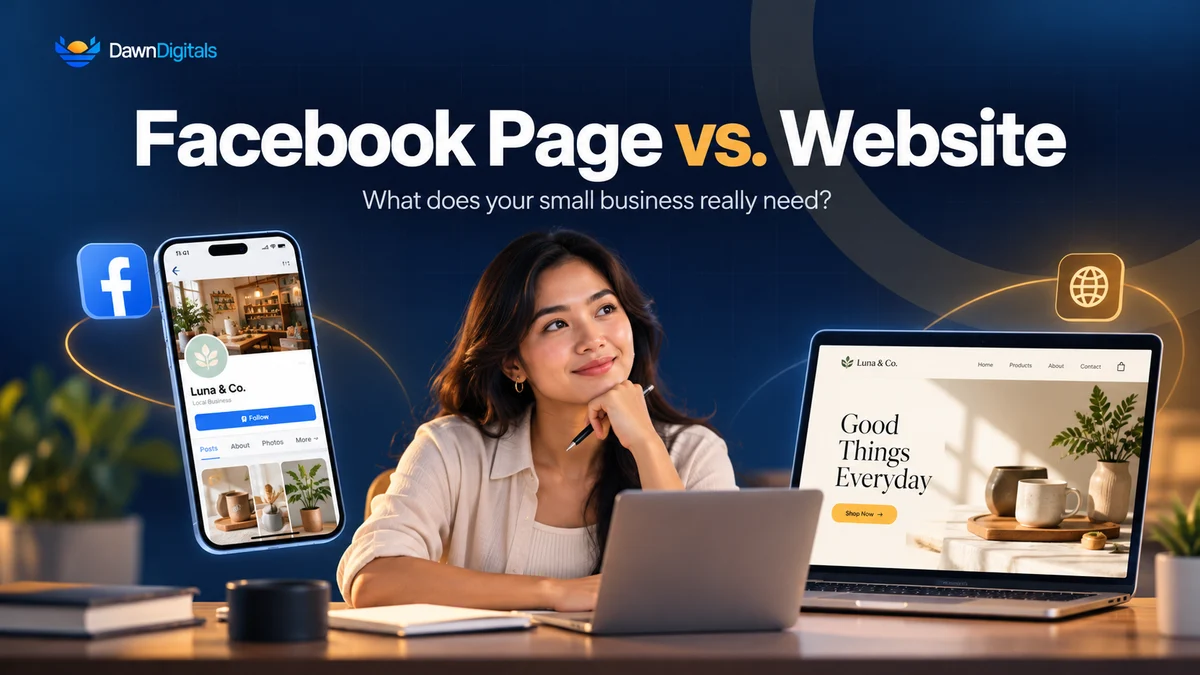
Your Facebook Page helps people discover your business. But is it enough to turn interested visitors into paying customers?
For many small businesses in the Philippines, Facebook is the starting point of their online presence.
Whether you operate an auto repair shop, coffee shop, restaurant, resort, salon, professional service, or retail business, creating a Facebook Page is often one of the first steps toward reaching customers online.
And for good reason.
Facebook makes it easy to post updates, showcase products, interact with customers, and receive inquiries through Messenger. You can begin building an audience without investing in a professionally developed website.
But as your business grows, an important question eventually comes up:
Is having a Facebook Page enough, or should your business also have a website?
The answer depends on your business goals, how customers discover your services, and what information they need before making a purchase decision.
Let's explore what each platform offers, where each falls short, and how they can work together to help your business grow.
1. Why So Many Filipino Businesses Rely on Facebook
Facebook has become an important part of how many businesses in the Philippines communicate with customers.
For small business owners, it offers several practical advantages.
It's easy to get started
You can create a business page, upload your logo, add contact information, and begin posting products or services without hiring a developer.
This makes Facebook especially useful for newly established businesses with limited budgets.
You can communicate directly with customers
Messenger allows potential customers to ask questions, request quotations, inquire about availability, and arrange appointments.
That direct communication is valuable, especially for businesses that rely heavily on customer relationships.
It helps you build an audience
Photos, videos, promotions, customer reviews, and community engagement can introduce your business to potential buyers.
For example, a newly opened coffee shop can post photos of its drinks, announce promotions, and encourage customers to share their experiences.
Customers are already familiar with the platform
Many customers are comfortable browsing Facebook Pages and sending messages through Messenger.
Businesses can take advantage of that familiarity to reduce the effort required to make an inquiry.
The takeaway: Facebook is an excellent platform for visibility, engagement, and communication. For some small businesses, it may be enough during the early stages.
However, being active on Facebook doesn't automatically mean customers can easily find all the information they need about your business.
2. The Limitations of Relying Only on a Facebook Page
Imagine a potential customer hears about your business through a recommendation.
They search for your business name online because they want to know more before contacting you.
They want to see your services, business background, previous work, operating hours, contact details, and perhaps an explanation of what makes your business different.
They find your Facebook Page.
But instead of a clearly organized presentation, they must browse through numerous posts, promotional announcements, shared content, and photos.
Your important information might be there. The problem is that finding it can require more effort than necessary.
This highlights some limitations of relying exclusively on Facebook.
Important information can get buried
Facebook organizes much of your content around posts and updates.
A detailed post about your services might eventually become difficult to locate as newer content appears.
While you can use pinned posts, featured content, and page information, you still have limited control over how everything is presented.
You have limited control over the customer experience
Facebook provides a predefined interface.
You can customize your profile information, images, and content, but you cannot fully design how customers navigate your business information.
For businesses with multiple services, packages, project portfolios, or booking requirements, this can become restrictive.
Your business depends on a third-party platform
Facebook determines how its platform operates, including content distribution, interface features, and account policies.
Changes to the platform can affect your ability to reach followers and communicate with customers.
A business that relies entirely on one platform can become vulnerable to those changes.
Not every customer starts their search on Facebook
Some people search directly through Google. Others use Google Maps, online directories, or AI-powered search tools.
A public Facebook Page can appear in search engine results, but having your own website gives you additional opportunities to present dedicated information about your business.
The takeaway: Facebook is valuable, but it may not provide the structure, flexibility, or control your business needs as it expands.
3. What Does a Professional Website Actually Do for Your Business?
A website is more than a digital brochure.
When planned properly, it becomes a central place where potential customers can understand your business, evaluate your credibility, and take action.
Let's look at its practical value.
A. It helps establish professional credibility
Before choosing a service provider, customers often want reassurance that they are dealing with a legitimate and reliable business.
A professional website gives you space to present your business consistently.
You can showcase:
- Your company background and experience
- Services, products, and specializations
- Previous projects and actual work
- Customer testimonials and reviews
- Qualifications, certifications, or professional credentials
- Business location and contact information
Consider a customer comparing two service providers offering similar services.
One has a Facebook Page with occasional posts.
The other has an organized website showing its services, relevant experience, project photos, and clear contact information.
The website doesn't automatically make the second business better. However, it may make evaluating that business easier and help build confidence in the decision.
Customers are not just buying a product or service. They are also deciding whom they can trust.
B. It helps customers find information faster
Your customers should not have to scroll through months of Facebook posts to understand what you offer.
A website allows you to organize information into dedicated pages.
For example, an automotive repair shop might have pages for:
Home: An introduction to the shop and its main services.
Services: Preventive maintenance, diagnostics, air-conditioning repair, brake services, and other offerings.
About: The shop's background, experience, and approach to customer service.
Gallery: Photos of the facility, equipment, and completed work.
Contact: Location, business hours, phone number, and inquiry options.
Within a few minutes, potential customers can understand what the shop offers and decide whether to make an inquiry.
This creates a more convenient experience for people who prefer researching before reaching out.
C. It creates additional opportunities to appear on Google
Imagine someone searching Google for:
"Car aircon repair in General Santos City"
Or:
"Wedding resort in South Cotabato"
Or:
"Law office services in Bohol"
If your business has a relevant website with clear information about its services and location, search engines have additional pages they can discover and potentially display for related searches.
This is where Search Engine Optimization (SEO) becomes valuable.
SEO involves improving your website's structure, content, technical performance, and relevance so search engines can better understand what your business offers.
A website also allows you to publish service-specific pages and helpful articles addressing customer questions.
However, an important distinction is that having a website does not automatically guarantee high Google rankings or more customers.
Search visibility depends on factors such as competition, website quality, relevant content, technical accessibility, and the ongoing effort invested in your online presence.
For local businesses, a properly maintained Google Business Profile can also complement your website by helping customers find your business through Google Search and Maps.
D. It gives you more control over your brand
On Facebook, every business operates within a familiar platform design.
Your website gives you much more freedom to build an experience around your business identity.
You can choose your layout, colors, typography, photographs, and content structure.
For a resort, this might mean large photographs highlighting the property and its amenities.
For a law office, it could mean a clean, professional presentation of practice areas and credentials.
For a coffee shop, it might involve displaying the menu, location, operating hours, and ordering options.
A consistent presentation helps customers recognize your brand.
And with your own domain name, you create a recognizable online address that can appear on business cards, quotations, invoices, marketing materials, and social media profiles.
E. It can turn customer interest into action
Attracting visitors is only part of the process.
You also want to make it easy for them to take the next step.
A well-designed website can guide customers toward actions such as:
- Sending an inquiry
- Requesting a quotation
- Booking an appointment
- Calling your business
- Viewing directions to your location
- Placing an order
- Starting a Messenger or WhatsApp conversation
These are known as calls to action (CTAs).
Instead of simply presenting information, your website can direct visitors toward an appropriate next step.
For example, after reading about your automotive repair services, a customer could immediately select "Request an Appointment."
The key is to make contacting your business simple and convenient.
4. Facebook Page vs. Website: A Side-by-Side Comparison
Both platforms offer value, but they serve different purposes.
Scroll across the comparison on smaller screens.
| Feature | Facebook Page | Business Website |
|---|---|---|
| Initial setup | Generally free and easy | Requires development and possibly professional assistance |
| Customer engagement | Excellent for comments, messaging, and social interaction | Supports inquiries, forms, and other integrated communication tools |
| Content presentation | Primarily social posts and platform-defined sections | Customizable pages organized around your business |
| Branding | Limited to Facebook's interface | Greater control over design and brand identity |
| Google visibility | Public pages and posts may appear in search results | Dedicated pages can be optimized for relevant search queries |
| Services and portfolio | Possible, but less flexible | Dedicated service pages and structured portfolios |
| Online booking | Depends on available platform features and integrations | Can support customized booking and inquiry systems |
| Platform control | Governed by Meta's platform rules | More control over content and functionality, subject to hosting and service arrangements |
| Ongoing costs | Free basic page, with optional advertising | Domain, hosting, maintenance, and possible service fees |
The key difference: Facebook is built primarily for social interaction, while a business website can be designed specifically around your customers' information needs and your business goals.
Neither option automatically produces better results. Their value depends on how effectively you use them.
5. When Is a Facebook Page Enough?
Not every business needs to invest in a website immediately.
For some small businesses, Facebook can be a practical starting point.
Consider a home-based food seller who primarily accepts orders from relatives, friends, and nearby customers.
They publish their daily menu, receive orders through Messenger, and arrange deliveries directly.
If their current approach meets their needs and they are not actively trying to reach customers through search engines, a Facebook Page may be sufficient for now.
Similarly, a new business testing its products and building an initial customer base may choose to prioritize Facebook before expanding its digital presence.
A Facebook-first approach may be reasonable if:
- Your business is still testing its market.
- Most customers already come through personal recommendations or social media.
- You offer only a few simple products or services.
- Your budget is limited.
- You can manage customer inquiries effectively through Messenger.
The important thing is to recognize when your business needs begin to change.
As your customer base expands, your range of services grows, or your customers require more information, a website can become a worthwhile next investment.
6. When Should Your Business Consider Having a Website?
A website becomes particularly valuable when your business needs a stronger, more organized digital presence.
Here are common signs that it may be time to invest.
Customers repeatedly ask the same questions
If you frequently answer inquiries about services, packages, pricing, location, or business processes, a website can provide an accessible reference.
Instead of explaining everything from the beginning, you can direct customers to the relevant page.
You want to attract customers beyond your existing followers
A website can create opportunities to reach people searching for services on Google, even if they have never encountered your Facebook Page.
You offer services that require explanation
Businesses such as engineering firms, clinics, consulting companies, legal practices, and specialized repair shops often need to explain their services and qualifications in detail.
A structured website can make that information easier to understand.
You want to showcase previous projects
A portfolio lets customers evaluate the quality and scope of your work.
For service businesses, actual project examples can be especially valuable during the decision-making process.
You want a more consistent professional identity
A dedicated domain and branded website can make your business easier to recognize across marketing materials, online platforms, and customer communications.
You want to simplify customer inquiries or bookings
A website can support customized forms, appointment requests, ordering workflows, and other processes that help organize interactions with customers.
If several of these situations describe your business, a website may provide meaningful value beyond simply having another online page.
7. How Facebook and Your Website Can Work Together
One of the biggest misconceptions about creating a website is that it means replacing Facebook.
In reality, the two can complement each other.
Think of them as different parts of your customer journey.
Step 1: Attract attention through Facebook
A customer encounters a post featuring your services, a recent project, or a promotional offer.
The content captures their interest.
Step 2: Help them learn more through your website
They visit your website to explore your services, review your work, understand your experience, and check important details.
This gives them an organized way to evaluate your business.
Step 3: Make it easy to contact you
Once they are ready, they can send an inquiry, request a quotation, book an appointment, or return to Messenger.
Your website and social media channels work together rather than competing for attention.
Step 4: Build long-term discoverability
Over time, your website can also attract visitors through relevant Google searches.
Meanwhile, your Facebook Page continues to support community engagement, updates, and customer relationships.
Facebook helps start conversations. Your website can help customers find the information and confidence they need to continue those conversations.
8. Illustrative Example: An Automotive Repair Shop
Imagine an automotive repair shop operating in General Santos City.
The owner already maintains a Facebook Page.
They regularly upload photographs of completed repairs, maintenance work, and satisfied customers.
Their page receives inquiries, but potential customers often ask similar questions:
"Do you repair automotive air-conditioning systems?"
"Where exactly is your shop?"
"What other services do you offer?"
"Can I schedule an appointment?"
A website could help organize those answers.
The shop might publish a dedicated page explaining its automotive air-conditioning services, another page for preventive maintenance, and a contact page containing its location and appointment inquiry options.
Customers who discover the shop on Facebook can visit the website for additional information.
At the same time, someone searching Google for automotive repair services in General Santos City may discover the shop's website through relevant search results.
The owner can still use Facebook for promotions, updates, and direct communication.
The website simply provides another way for customers to discover and evaluate the business.
This illustrates an important principle:
A website doesn't have to change how your business operates. It should support how customers find, understand, and contact your business.
9. How Much Should a Small Business Invest in a Website?
Cost is an important consideration, especially for small business owners managing limited budgets.
Website development costs in the Philippines can vary significantly depending on what the project requires.
A simple informational website will generally require less work than a website with online ordering, customer accounts, payment processing, or a custom booking system.
When evaluating a website proposal, consider the following components.
Domain name: Your website's online address, such as yourbusiness.com. Domain registration normally requires recurring renewal payments.
Hosting: The infrastructure used to make your website accessible online. Costs depend on the hosting service and technical requirements.
Design and development: The work required to plan, design, build, and test the website.
Content: Written information, images, service descriptions, and other materials that help customers understand your business.
SEO setup: Foundational work that makes your website easier for search engines to discover and understand.
Maintenance: Updates, security monitoring, troubleshooting, and ongoing technical support, depending on your chosen setup.
Before choosing a provider, ask for a clear explanation of what is included.
You should understand which costs are one-time, which are recurring, who controls the domain and hosting accounts, and whether future updates are included.
A website should be evaluated as a business investment, not simply as a design expense.
The most useful question is not necessarily, "How cheaply can I get a website?"
It is:
"What does my business need this website to accomplish?"
A small, focused website that clearly presents your services and makes inquiries convenient may be more valuable than a complicated website filled with features your customers never use.
10. What Should Your First Business Website Include?
Your first website does not need dozens of pages.
For many small businesses, a simple and carefully planned structure is enough to get started.
Home Page
Explain what your business does, whom you serve, and why a potential customer should consider your services.
Make your main contact or inquiry option easy to find.
Services or Products Page
Present your offerings in a clear, organized format.
Help visitors understand what is available and whether your business meets their needs.
About Page
Introduce your business, experience, values, team, or relevant qualifications.
Give customers an opportunity to learn who is behind the services.
Portfolio or Gallery
Showcase actual work, projects, facilities, or products where appropriate.
Use genuine photographs and examples that represent your business accurately.
Contact Page
Make it easy for customers to reach you.
Include appropriate contact information, location, operating hours, and inquiry methods.
Depending on your business, you can also add customer reviews, frequently asked questions, a blog, an online booking feature, or an ordering system.
Your website can grow as your business needs evolve.
11. Common Questions About Facebook Pages and Websites
Can my Facebook Page appear on Google?
Yes. Public Facebook Pages and some publicly available content can appear in Google Search results.
However, appearance in search results is not guaranteed. A dedicated website gives you additional control over page content, structure, and search optimization.
Will having a website automatically bring me more customers?
No.
A website creates opportunities for people to discover and evaluate your business, but results depend on how effectively the website supports your customers' needs.
Relevant content, SEO, marketing, customer experience, and ongoing improvement all contribute to its effectiveness.
Do I still need Facebook if I already have a website?
If Facebook is where your customers interact with your business, it remains valuable.
A website can provide detailed information, while Facebook continues to support social engagement and direct communication.
Do I need a website even if my business does not have a physical store?
Not necessarily, but a website can still be useful.
Home-based businesses, freelancers, consultants, and online service providers can use websites to showcase their offerings, explain their processes, and receive inquiries.
Is a one-page website enough?
For some businesses, yes.
A well-structured one-page website can introduce your company, summarize services, showcase selected work, and provide contact information.
Businesses with numerous services, locations, or more detailed content may benefit from multiple pages.
Can I update my website after it is launched?
Yes, although the process depends on how the website is built.
Some websites include a content management system that allows business owners to make their own updates. Others may require assistance from a developer.
Discuss ongoing updates and maintenance with your provider before proceeding.
12. Final Thoughts: Your Business May Need More Than One Online Platform
So, what does your small business really need: a Facebook Page or a website?
The answer is not always one or the other.
Facebook is excellent for building connections, engaging with customers, and sharing updates.
A website provides a dedicated space to present your business, organize information, build credibility, and create opportunities for search visibility and customer inquiries.
For businesses just getting started, Facebook may be a practical first step.
For businesses ready to strengthen their professional presence, reach customers through additional channels, or provide a better information experience, a website can be a valuable investment.
And for many growing businesses, using both platforms together is a sensible strategy.
The goal should never be to have a website simply because other businesses have one.
The goal is to make your business easier to discover, easier to understand, and easier to contact.
Because when potential customers are ready to make a decision, the information they find about your business can influence whether they take the next step.
Ready to Build a Stronger Online Presence?
At DawnDigitals, we help businesses establish a professional digital presence designed around real business needs.
Our services include:
- Business Website Development — Present your services, showcase your work, and make it easier for customers to contact you.
- Search Engine Optimization (SEO) — Improve your website's foundations for search engine discovery.
- Business Profile Setup — Help customers find relevant business information through Google Search and Maps.
Whether you're starting with your first website or improving an existing online presence, we can help you explore a solution that fits your goals and budget.
Your business deserves an online presence that works for your customers—not just another place to post updates.
Let's talk about what your business needs.
Explore our services or request a free consultation to discuss your next step.
DawnDigitals — Web • Brand • Grow